
How to Identify Fake Perfume vs Authentic
Five checks that catch counterfeit perfume before you buy: batch codes, box seams, glass weight, price floor, and cap action, explained with real thresholds.
A bottle can look right in every product photo and still be counterfeit. The tells that actually matter rarely show up in a listing image: batch codes, glass weight, box seam quality, and a price that doesn’t add up. Here’s what to check before anything touches your skin.
What’s the fastest way to check if a perfume is fake?
Run five checks in order: the batch code, the box seam and cellophane, the glass weight and cap action, the spray pattern, and the price. Any one red flag is worth a second look; two or more means walk away from that specific listing.
The batch code and price check take under a minute and catch most counterfeits without needing the bottle in hand, which makes them the best first filter when you’re shopping online rather than in a store.
How do you read a perfume batch code?
Every legitimate bottle carries a small printed or laser-etched code, usually on the base of the bottle or the bottom flap of the box. Free batch-code lookup tools (Check Fresh, Check Cosmetic, and similar) decode it into an estimated manufacture date.
A code that the tool can’t parse, or a manufacture date that’s years old for a fragrance still in normal production and distribution, both suggest the stock didn’t come through an authorized channel. This check alone won’t prove authenticity, since codes can be copied onto fake boxes, but a failed check is a reliable disqualifier.
What physical details separate real bottles from counterfeits?
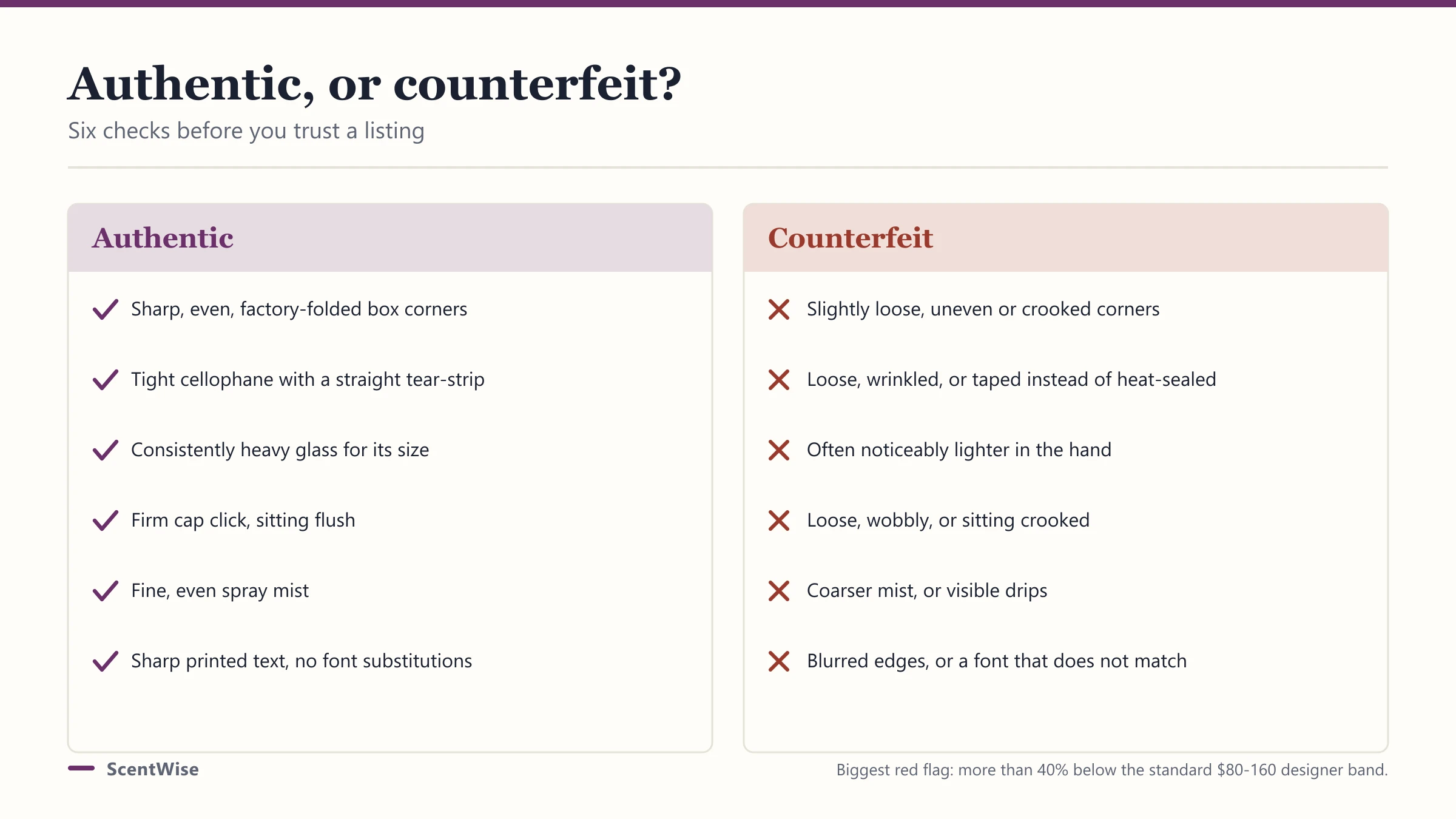
Authentic packaging is made to a tight tolerance; counterfeit packaging is made to look right in a photo, not in your hand.
| Feature | Authentic | Counterfeit |
|---|---|---|
| Box seam | Sharp, even, factory-folded corners | Slightly loose, uneven, or crooked corners |
| Cellophane wrap | Tight, with a straight factory tear-strip | Loose, wrinkled, or taped instead of heat-sealed |
| Glass weight | Consistently heavy for its size | Often noticeably lighter |
| Cap action | Firm click, sits flush | Loose, wobbly, or sits slightly crooked |
| Spray pattern | Fine, even mist | Coarser mist or drips |
| Printed text | Sharp, no font substitutions | Slightly blurred edges or a font that doesn’t match reference photos |
No single row is conclusive on its own. Three or more mismatches against verified reference photos of the same batch is a strong signal.
Is a dupe the same thing as a fake perfume?
No, and mixing these up costs people money and trust in the wrong places. A dupe is an independently formulated, openly sold fragrance from a different brand, built to smell similar to a designer scent and marketed honestly as an alternative. A fake is a counterfeit of the original bottle, packaging and all, made to trick the buyer into thinking they bought the genuine product.
Buying a dupe is a normal, legal purchase decision. Buying a fake, even unknowingly, means you paid for a counterfeit that skipped every quality and safety standard the real manufacturer follows. Our perfume dupes guide covers legitimate alternatives if the price of the original is the actual problem you’re solving.
Why does an unusually low price matter so much?
Because the supply chain for genuine designer fragrance has a floor. A standard 50-100ml designer bottle typically runs $80-160 retail, and niche or luxury houses run $200-450 and up. A listing at 40% or more below that band, especially for a current, non-clearance release, usually means the stock is diverted, expired, or counterfeit.
Legitimate discounts exist during sales events and on older formulations being phased out, so context matters. A steep discount on a single listing from an unfamiliar third-party seller is the pattern to be cautious about, not a storewide sale from a retailer you already trust.
Does EDP vs EDT on the label help you spot fakes?
Indirectly, yes. Concentration labeling follows fixed industry bands: Extrait de Parfum runs 20-40% fragrance oil, Eau de Parfum (EDP) runs 15-20%, and Eau de Toilette (EDT) runs 5-15%. A listing that mislabels the concentration, or sells an EDT at EDP pricing, is either careless or misleading.
Our EDP vs EDT vs Extrait guide breaks down exactly how these concentrations affect longevity and price, which makes it easier to tell when a listing’s numbers don’t line up with what the label claims.
Is niche perfume harder to counterfeit than designer?
Somewhat, mostly because the audience is smaller and more informed. Niche and luxury houses sell in lower volumes through tighter distribution, so counterfeiters focus their effort on high-volume designer bestsellers where the payoff is bigger. That doesn’t make niche immune, just a less common target.
If you’re deciding between the two categories in the first place, our niche vs designer perfume comparison explains what actually separates them beyond price and exclusivity.
Where should you actually buy to avoid this problem?
Buy direct from the brand, from the brand’s official retail partners, or from large retailers selling first-party stock rather than third-party marketplace listings. Department stores, brand flagship sites, and big beauty retailers selling their own inventory are the lowest-risk channels.
Our guide to buying authentic perfume online lists specific retailers by category, including which marketplace listings to avoid and which sellers consistently ship verified stock.
What should you do with a bottle you’re unsure about?
Run the five checks above against reference photos of the exact batch, and if two or more come back wrong, contact the seller’s platform for a refund rather than opening the bottle further. If the concern is a decant or split sample rather than a full retail bottle, the standards are different; see our guide to whether decant sellers are legitimate before you write off a small, unbranded vial as automatically suspect.
Frequently asked questions
Quick answers to what readers ask us most
How do I check a perfume batch code myself?
Find the small printed or engraved code on the base of the bottle or bottom of the box, then run it through a free batch-code checker or the brand's own verification tool. A code that returns no result, or a manufacture date more than a couple of years old for a scent still in current production, is worth questioning.
Do fake perfumes smell noticeably different from authentic ones?
Often yes, though not always right away. Counterfeits commonly use cheaper synthetic bases, so the opening can smell close while the mid and dry-down phases fall apart faster or smell thinner than the real formula. A bottle that fades to almost nothing within an hour on skin is a strong warning sign.
Is it safe to buy perfume on Amazon?
It can be, if you buy "Ships from and sold by Amazon.com" or a listing fulfilled directly by the brand, since third-party marketplace sellers are the main source of counterfeit stock. See our guide to buying authentic perfume online for retailer-by-retailer guidance.
What's the difference between a dupe and a fake perfume?
A dupe is a separate, legally sold fragrance formulated to smell similar to a designer scent, sold under its own brand name at a fraction of the price. A fake is a counterfeit of the original bottle itself, sold to deceive the buyer into thinking they're getting the real product. Our perfume dupes guide covers the first category in full.