
EDP vs EDT vs Extrait: Perfume Strength Explained
Extrait, EDP, and EDT differ in oil concentration, longevity, and price. Here's the exact percentage and hour range for each, plus how many sprays to use.
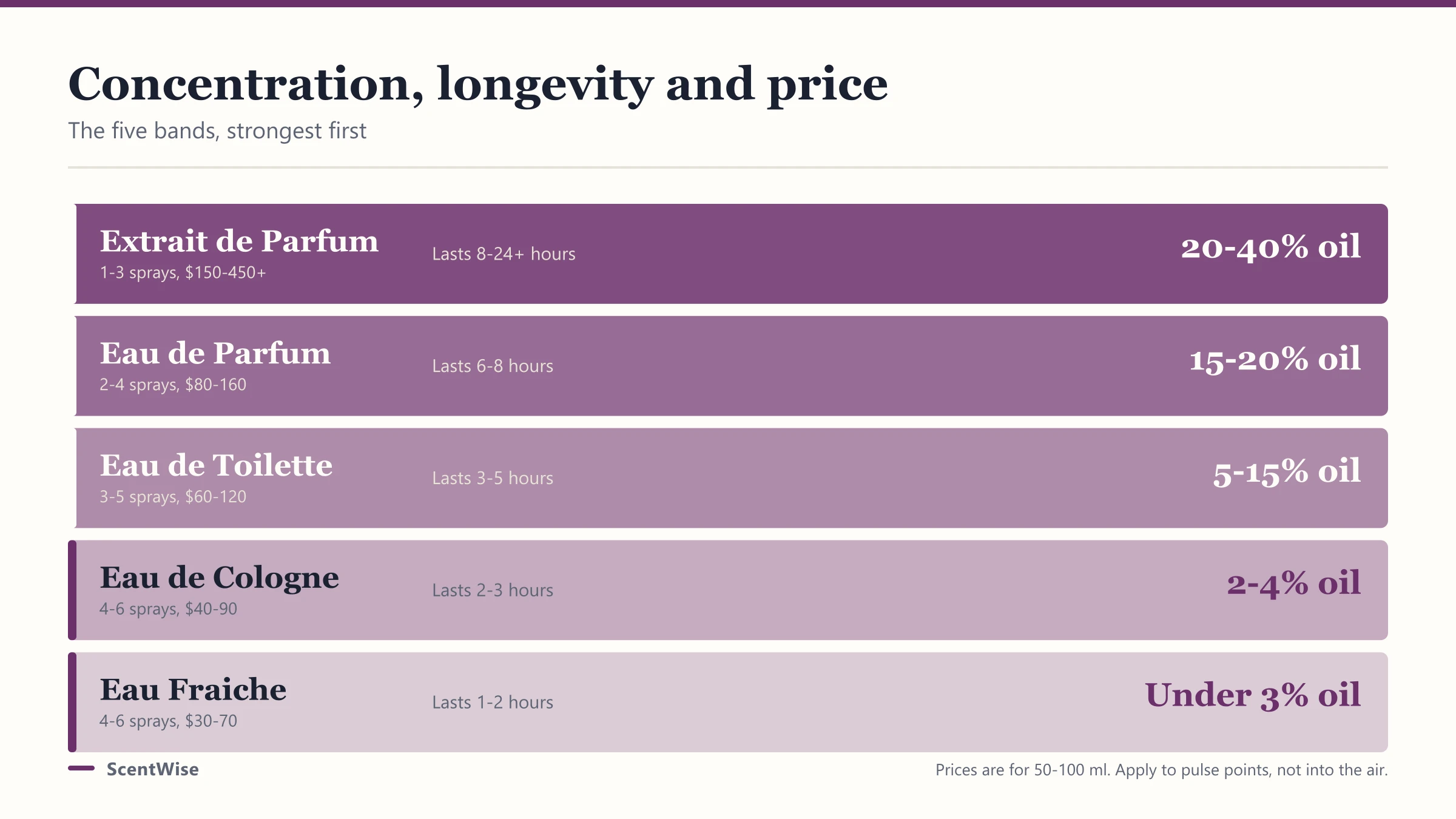
The letters after a fragrance name aren’t marketing fluff. EDP, EDT, and Extrait are legally defined concentration tiers that determine how strong a scent is, how long it lasts, and roughly what it should cost.
What do EDP, EDT, and Extrait actually mean?
They describe how much fragrance oil is dissolved in the alcohol and water base. Extrait de Parfum is the strongest at 20-40% fragrance oil. Eau de Parfum (EDP) runs 15-20%. Eau de Toilette (EDT) runs 5-15%. Two lighter tiers exist below that: Eau de Cologne (EDC) at 2-4% and Eau Fraiche under 3%.
More oil means a stronger scent, longer wear, and usually a higher price, since fragrance oil is the most expensive ingredient in the bottle.
How do all five concentration tiers compare?
| Concentration | Oil % | Typical longevity | Sprays | Price band (50-100ml) |
|---|---|---|---|---|
| Extrait de Parfum | 20-40% | 8-24+ hours | 1-3 | $150-450+ |
| Eau de Parfum (EDP) | 15-20% | 6-8 hours | 2-4 | $80-160 |
| Eau de Toilette (EDT) | 5-15% | 3-5 hours | 3-5 | $60-120 |
| Eau de Cologne (EDC) | 2-4% | 2-3 hours | 4-6 | $40-90 |
| Eau Fraiche | under 3% | 1-2 hours | 4-6 | $30-70 |
Note that price bands overlap across tiers since brand, ingredient quality, and whether it’s designer or niche all move the number independently of concentration.
Which concentration actually lasts the longest?
Extrait de Parfum, by a wide margin, at 8-24+ hours compared to EDP’s 6-8 hours and EDT’s 3-5 hours. The gap comes from both the higher oil percentage and the heavier base notes typically used in extrait formulas, which evaporate more slowly than the lighter top notes EDT leans on.
Skin type, weather, and application site all shift these ranges too. Oily skin and applying to pulse points where blood vessels sit close to the surface, wrists, neck, and chest, both extend wear time regardless of concentration.
How many sprays should you actually use?
Match the spray count to the concentration: 1-3 sprays for extrait, 2-4 for EDP, and 3-5 for EDT, always applied to pulse points rather than sprayed into the air and walked through.
Starting low and adding one spray at a time avoids the most common mistake, over-applying a strong extrait the same way you’d apply a light EDT. If you can’t smell your own fragrance after five minutes, that’s nose fatigue, not proof you need more product; ask someone else before adding another spray.
Why do some bottles just say “Parfum” instead of one of these terms?
Because “Parfum,” “Pure Perfume,” and “Extrait de Parfum” are generally used to mean the same thing: the 20-40% concentration tier. Brands pick whichever term fits their labeling style, so don’t assume a bottle labeled simply “Parfum” is a different, unlisted category from Extrait.
“Cologne” causes the opposite confusion. In everyday speech, people use “cologne” to mean any men’s fragrance regardless of concentration, while Eau de Cologne is technically the specific 2-4% tier. A bottle marketed as a men’s “cologne” at EDT or EDP concentration is common and not a labeling error; check the small print on the box for the actual concentration term if it matters for your purchase.
Can you reapply throughout the day instead of buying a stronger concentration?
Yes, and for EDT or EDC wearers this is often more practical than switching tiers. A midday touch-up of 1-2 sprays on a pulse point restores projection without needing to carry a different bottle, and it gives you more control over strength than committing to extrait for an entire day.
This is also where bottle size matters. A 2-10ml decant or travel atomizer is easy to carry for a midday reapplication, while a full 100ml bottle is not something most people carry around. Keep a small refillable atomizer in a bag if reapplication is part of your routine.
Does concentration change the price you should expect to pay?
Yes, and it’s a useful check against overpriced or suspicious listings. A 50-100ml bottle at extrait concentration reasonably costs $150-450+, while the same fragrance name at EDT concentration should run closer to $60-120. A listing that charges extrait prices for an EDT bottle, or the reverse, is worth double-checking against the label.
Concentration mislabeling is also one of the signals covered in our guide to identifying fake perfume, since counterfeiters sometimes mismatch the concentration claim to the packaging they’re copying.
Which concentration should you buy first?
EDP, for most people starting out. It sits in the middle of the range: strong enough to last a full workday at 6-8 hours, priced in the accessible $80-160 band, and versatile enough for most climates and occasions. EDT is the better starting point in hot climates or for daytime office wear, where a lighter, shorter-wearing scent is actually preferable.
Extrait is worth reaching for once you already know a scent works on you and want the longest wear for evenings or special occasions, covered in more depth in our longest-lasting perfumes guide.
Does concentration matter when you’re packing for travel?
It does, on two fronts. First, TSA’s carry-on liquid limit is 3.4oz/100ml per container, so a full 100ml EDP bottle sits right at the ceiling while a 50ml bottle leaves margin. Second, a higher concentration lets you pack a smaller bottle and still get full-day wear, which matters when luggage space is tight.
Our travel-size perfume guide covers exactly which sizes clear security without issues and how to choose concentration for a trip where you can’t reapply midday.
Match concentration to how long you need the scent to last and where you’ll wear it, not to whichever bottle happens to be cheapest at the store. The letters on the label tell you more than the marketing copy does.
Frequently asked questions
Quick answers to what readers ask us most
Is Extrait de Parfum always better than EDP?
Not necessarily better, just stronger and longer-lasting at 20-40% concentration versus EDP's 15-20%. Extrait is more expensive per bottle and can feel too heavy for daytime or hot weather, so EDP is often the more practical everyday choice even though extrait technically has more fragrance oil.
Why do the same fragrance name's EDP and EDT smell different?
Higher concentration doesn't just make a scent stronger, it changes the balance of top, heart, and base notes, since more oil means more of every note is present relative to the alcohol and water base. EDT versions often smell brighter and more top-note-forward; EDP and extrait versions lean into the base notes more.
How many sprays of EDP should I use?
2-4 sprays on pulse points (wrists, neck, chest) is the standard range for EDP. Start at 2 and add more only if you can't smell it on yourself after a few minutes, since over-spraying is the most common application mistake.
Does a higher concentration mean the bottle lasts longer before running out?
Not proportionally, since you use fewer sprays of a stronger concentration. A 50ml extrait bottle used at 1-3 sprays a day and a 50ml EDT bottle used at 3-5 sprays a day tend to run out on a similar timeline, even though the extrait is the stronger formula.